Interested in joining us?
Visiting scientists: Visitors are welcome! The Garden is set up to accommodate, with inexpensive but suitable short-term apartment rentals, working spaces, the world’s largest herbarium, and welcoming people. The Garden also has a number of short-term fellowships for professionals interested in working here for a few weeks.
Postdocs: I’m more than happy to help prospective students and postdocs write grants to work in our lab! The Missouri Botanical Garden, and especially our department, always has a cadre of postdocs.
Graduate students: We host grad students from any of the area universities, especially Washington University in Saint Louis and the University of Missouri–Saint Louis where I hold adjunct appointments so can advise students. I also work remotely with students and postdocs at locations far from Saint Louis, though I am not a Zoom warrior so really prefer in-person.
Undergraduate students: We have hosted a number of undergraduate students for summer or semester-long (or longer) research projects. Many of the students who have worked with us have simply come with the question, “How can I get involved?” Often, students can get class credits for their research or can do summer-long projects, such as through WUSTL’s SURGE program. Additionally, the Missouri Botanical Garden has a long-standing, thriving, expenses-paid Research Experience for Undergraduates summer session for which I often serve as a mentor.
Mentoring
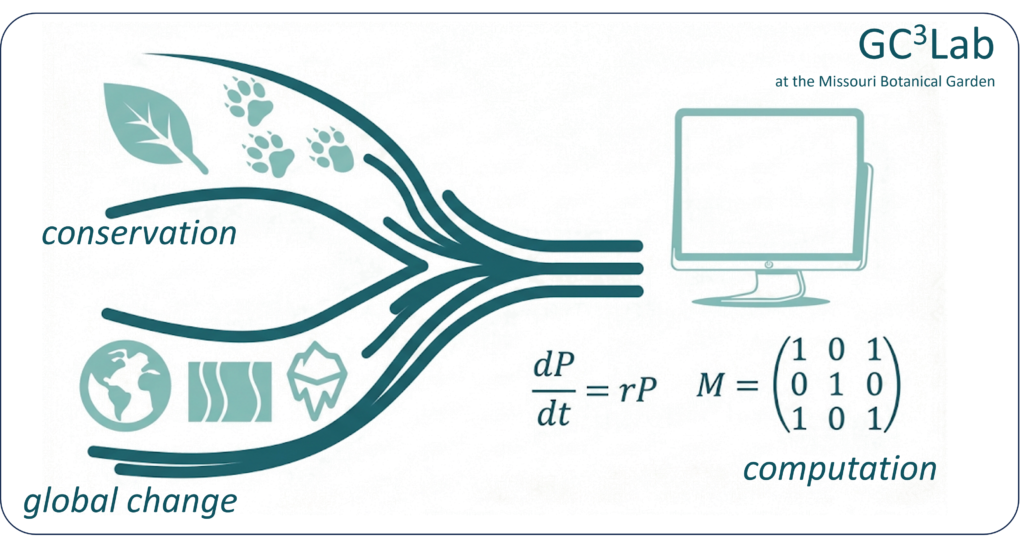
My approach to mentoring is driven by the same motivation that drew me to conservation: I seek to be of service to the world. As a result, I seek to be of service to you and my other mentees, regardless of whether we meet just once for consultation or work together as colleagues for decades. Having followed a non-traditional path to academic research myself, I support you regardless of whether you seek to remain in the research and teaching fields or seek any of life’s other worthy endeavors. My approach to mentoring is informed by my own experiences (both very bad and very good) as a student and experience teaching about 500 students of all levels (kindergarten through graduate). I am interested in whatever you are interested in, though I am am especially good subject-matter mentor for people interested in combining research into a) past or future global change or b) conservation with c) spatial or temporal modeling.
Approach
The three roles a mentor plays are: teacher, partner, and cheerleader. I seek to be each of these as you require throughout your tenure working with me. Since every person is different, I cannot “prescribe” an approach until I work with you a bit, but as time passes, our roles will evolve. Wherever we start, my goal in mentoring is to end as your “cheerleader”—you need to go on and do even greater things, regardless of whether that ends in becoming dean of a prestigious academic department or teaching English to schoolkids in rural Japan.
I offer as much support as I can, but I also expect you to ask for help when you need it, especially when I am unable to provide it. For postdocs (and anyone else interested), this involves developing a personal and individual development plan which we use to design experiences during your time with me.
When I cannot provide mentorship in a specific area, I will seek to connect you with people who can. For example, I have arranged for mentees of historically underrepresented groups to have a secondary advisor who could understand, from personal experience, the situation mentees find themselves in. I am especially sensitive to “non-obvious” minorities (i.e., people who identify with a profile that is not described by a traditional “ism” like racism, sexism, ageism, etc.) and to people with non-neurotypical mentalities (ASD, VAST/ADHD, etc.). My experience with non-neurotypicals is informed by living with neurodiverse family members, and involvement in the neurodiversity advocacy community.
I firmly believe in putting one’s identify and health first, before work and before obligations. I encourage mentees to have a healthy work/life integration and to take time off, and expect the same of myself. I especially encourage anyone working in ecology to actively engage with and experience nature, since that is the reason we are here.
Time
Time is the coin of our lives, and I like to spend mine on mentoring. You can expect to meet with me tête-à-tête on a weekly basis, or more as needed. In turn, if at all possible, I invite and expect you to attend weekly lab meetings. Most people find that most of their mentoring comes through interaction with their peers, so this is an important part of developing yourself professionally and personally.
Finally, I offer “mentoring for life”—a gift given by my own graduate mentor, and one I want to pass on.